
What the new guidance actually does
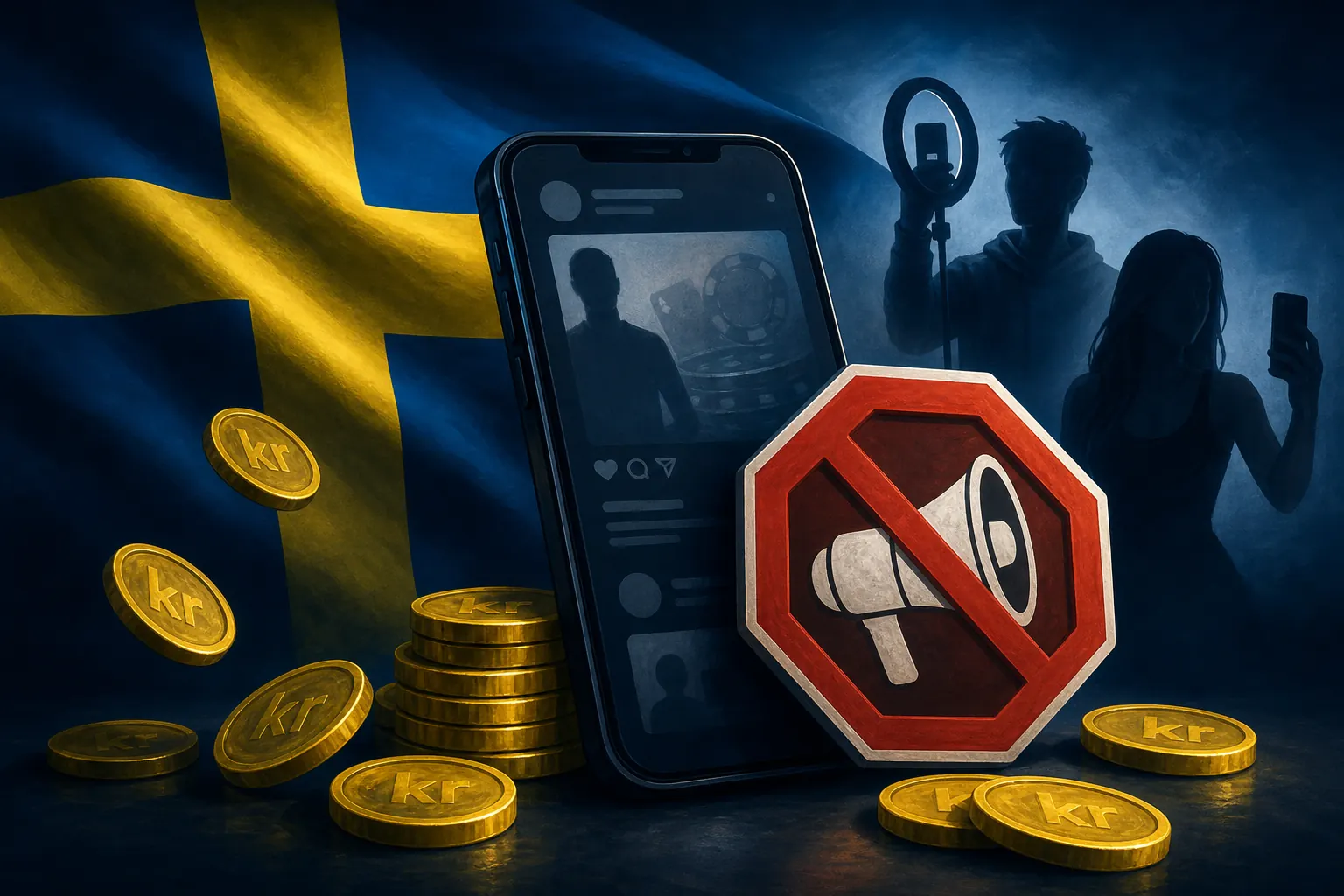
Numbered ALLM 2026:04, the new guidance is issued under Spellag 2018:1138 and plugs in alongside the existing rules on moderation and risk messaging. In plain terms, it stretches the 'måttfullhet' moderation standard to cover every Swedish-language promotion that lands on a social platform. It does not matter whether the post comes from a licensed operator, an affiliate under a signed contract, or an influencer being paid per upload - all three sit inside the same perimeter now.
The previous reading left influencer posts in a grey zone whenever the creator had no direct commercial tie to the licensee. Spelinspektionen has closed that door. Any paid or value-exchange promotion falls inside the advertising perimeter, and the regulator is explicit that free play credits and comped trips to events count as value exchanges.
The four triggers for an influencer promotion
The guidance lays out four triggers that drag a post into the advertising perimeter. The first is any monetary payment, however it is structured. The second is any non-cash value exchange, from bonuses to event access to branded merchandise. The third is any affiliate tracking link, even one posted without a disclosure line. The fourth is any post that names a specific operator, provided the influencer has flagged some form of relationship with that brand in the previous 180 days.
That fourth trigger is the one keeping influencer management agencies up at night. It catches the familiar sequence where a creator runs an unpaid stream in July, signs a one-off deal with the same brand in August, and then drops what looks like an organic follow-up post in September. Under ALLM 2026:04, the September post still reads as a promotion and is bound by the moderation standard.
Why this is a step up from the 2018 code
The 2018 Spelbranschens Advertising Code was industry self-regulation, with sanctions that never reached further than a member's standing in the trade body. ALLM 2026:04 lifts the same principles onto Spelinspektionen's sanctioning rail, which lets the regulator issue warnings, hand out fines of up to SEK 80 million, and, in the sharpest cases, open a licence review.
A Spelinspektionen spokesperson told Faders the point of the shift is enforcement teeth. 'The industry code did useful work,' she said. 'But a reputational sanction does not reach a creator who is not inside the trade body. ALLM 2026:04 means Spelinspektionen can act directly on the operator paying for the promotion, regardless of the publisher.'
Where the SEK 5,000 deposit cap fits in
All of this is layered on top of the SEK 5,000 monthly deposit cap that has shaped regulated Swedish online gambling since the pandemic. The cap is already up for a separate consultation, which we covered when Spelinspektionen opened its review back in August 2026, and a formal decision is not expected before Q1 2027.
The combined effect on the Swedish licensed market is cumulative pressure. The deposit cap tightens the top of the funnel, while the advertising rules reshape the funnel itself and cut off some of its reach. Channelization, the share of Swedish online gambling that stays at licensed operators, is now under 70% according to BOS's own count.
Why Swedish players keep drifting offshore
The predictable response to a tighter domestic regime is that higher-stake Swedish players start looking at non-SE licensed brands. Our utländska casino guide walks through how that market is put together, which licences are worth trusting, and where the real consumer-protection gaps sit.
That offshore pull is not a free lunch. Dispute-resolution routes, cross-operator self-exclusion and bonus protection are all weaker once a player steps outside the Spelinspektionen framework. We time payouts on both sides of the licensed line, and the gap is real: licensed Swedish operators land at a median of 2 hours, offshore brands at a median of 11 hours on the same methodology.
The enforcement puzzle Spelinspektionen still owes an answer on
ALLM 2026:04 is a guidance document rather than a statute. The real sanctioning power sits in Spellag, which hands Spelinspektionen a wide margin of discretion. The question the regulator has yet to answer is how hard it is willing to push on cross-border creators who have no Swedish legal nexus but whose content still reaches Swedish feeds through platform recommendation.
Spelinspektionen told us enforcement will go after paying operators before it goes after creators, since the operator licence is the easiest attachment point to pull on. Creators still carry platform-level risk, since TikTok and YouTube already act on regulator notices in Sweden.
Frequently asked questions
Does ALLM 2026:04 ban influencer casino promotion in Sweden?
No. It brings influencer promotion under the same moderation standard that already binds operator advertising, and gives Spelinspektionen a direct way to sanction the operator paying for the promotion.
What is the SEK 5,000 cap?
It is a monthly deposit limit that applies across every Spelinspektionen-licensed operator. Once a player hits it inside a calendar month, no licensed Swedish brand can accept another deposit from that player until the month resets.
Is the deposit cap also changing?
A separate consultation is open on raising or restructuring the cap. A formal decision is not expected before Q1 2027.
What should I do if I want to bet above the cap?
There are two legal routes. One is to stay with a Swedish licensed operator and accept the cap. The other is to move to an offshore brand that sits outside the Spelinspektionen framework, at the cost of weaker consumer protection on that side of the line.

Alexander Ekström
Alexander Ekström runs the Faders Sweden desk. Eight years inside Swedish online gambling compliance taught him to treat every ranked operator the same way: he signs up as a regular player, moves real kronor through the cashier, and times each withdrawal from first click to cleared balance.
About the desk ›